
Published 6 November 2026
EET 2.0 from 2027: what it means for a craft brewery
From 1 January 2027 electronic sales records (EET) return in the Czech Republic. Which payments a brewery records, what to do in DIS+ before the end of the year, and what to do when the internet goes down.
From 1 January 2027, electronic sales records return in the Czech Republic, this time as EET 2.0 under Act No. 180/2026 Coll. They also apply to craft breweries that sell directly to customers: over the counter, in their own taproom, or when a driver collects cash on a delivery. Registration has been open since 1 November 2026, so now is the time to prepare.
What changes compared with the original EET
- Only payments made in person with the customer are recorded, at the business's premises or in its vehicle.
- A receipt is not mandatory, and you don't have to print a confirmation code on it.
- No items or VAT rates are sent. The tax authority only gets the basics: who, when, how much, on which registered unit and cash register, and a sequence number.
- For small businesses, the tax authority is preparing a free web app, MOJE eet.
Which payments a brewery records
A recorded sale has to meet three conditions at once: it is a payment made in person (cash always), it is business income, and no exemption applies.
Recorded:
- cash, always, including cash a driver collects on a delivery,
- in person, payment by card on a terminal, by QR code, gift card, voucher or meal voucher,
- typically sales of bottles, cans and kegs over the counter and takings in your own taproom.
Not recorded:
- remote payments, for example when a pub pays an invoice by bank transfer from its office,
- cash on delivery collected for you by a postal service.
If a driver takes a payment at a pub other than in cash, such as by card or QR code, check with the tax authority's helpline whether it is a recorded sale. The rules speak of payments at the business's premises or in its vehicle.
What to do before the end of the year
- Activate your tax information box DIS+ on the MOJE daně portal (mojedane.gov.cz), for example with a bank identity or a data box. Access takes up to 48 hours, or up to 5 working days if the tax authority doesn't have you on record yet. Your accountant can also do the DIS+ steps if you authorise them there.
- Sign up for sales records in DIS+.
- Create the registered units. For a brewery this is usually the place where you sell (counter, taproom) and, if a driver collects cash, the delivery van. Each unit gets a number that is sent with every sale.
- Generate a cash-register certificate. It is free, valid for a year and can be used for several cash registers. Download the file straight away, as the portal deletes it after a while.
- Upload the certificate to your cash register following its supplier's instructions, and test the connection. The certificate from the original EET cannot be used for EET 2.0.
When the internet goes down
You can keep selling. Send the sales data as soon as the connection is back, no later than 48 hours after the sale. Most cash registers do this by themselves.
What about EET OFF?
The EET OFF mode lets selected self-employed people in the flat-rate tax regime skip reporting their sales. A brewery run as a limited company cannot use it.
How GF Brew App handles it
The cash register in GF Brew App sends sales to EET by itself:
- counter sales paid in cash or by QR code,
- cash collected by a driver on a delivery (in Czech crowns).
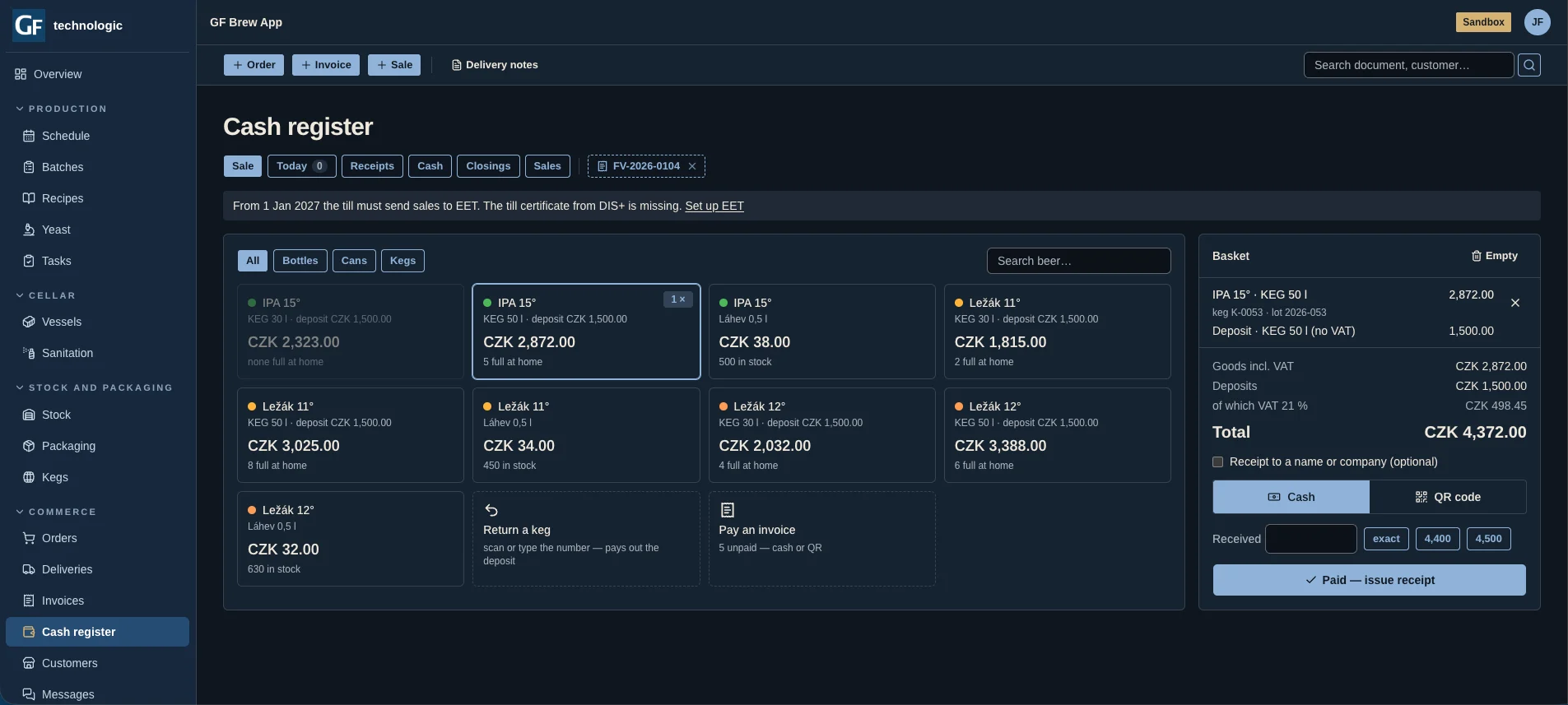
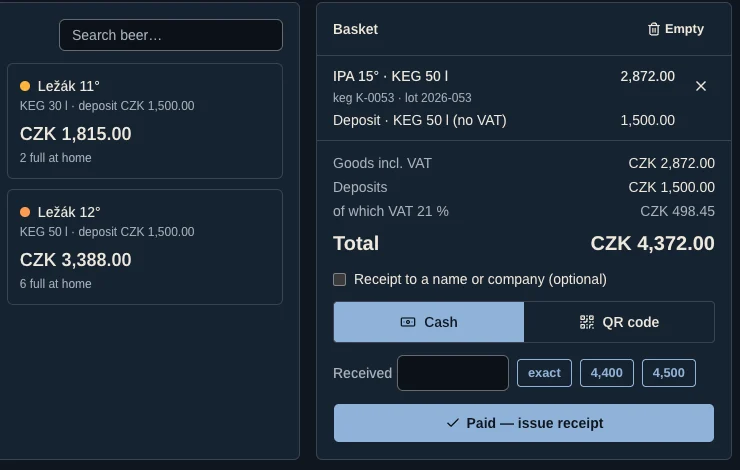
Once paid, the sale goes to EET by itself →
In the app, go to Settings → Sales → EET, upload the cash-register certificate from DIS+, fill in the establishment numbers Counter, taproom and, if needed, Delivery vehicle, and check the connection. If EET doesn't respond, sales don't stop and the app sends the sale later. The step-by-step procedure is in the EET guide.
This article summarises the rules as published by the Czech tax authority at eet.gov.cz as of 6 November 2026. It is not tax advice. For your specific situation, contact the tax authority's helpline or your tax advisor.